How I built a finance education platform from idea to launch in under a week
This looks like a story about building a website with AI. But there is a lot more to it than giving prompts to a tool.
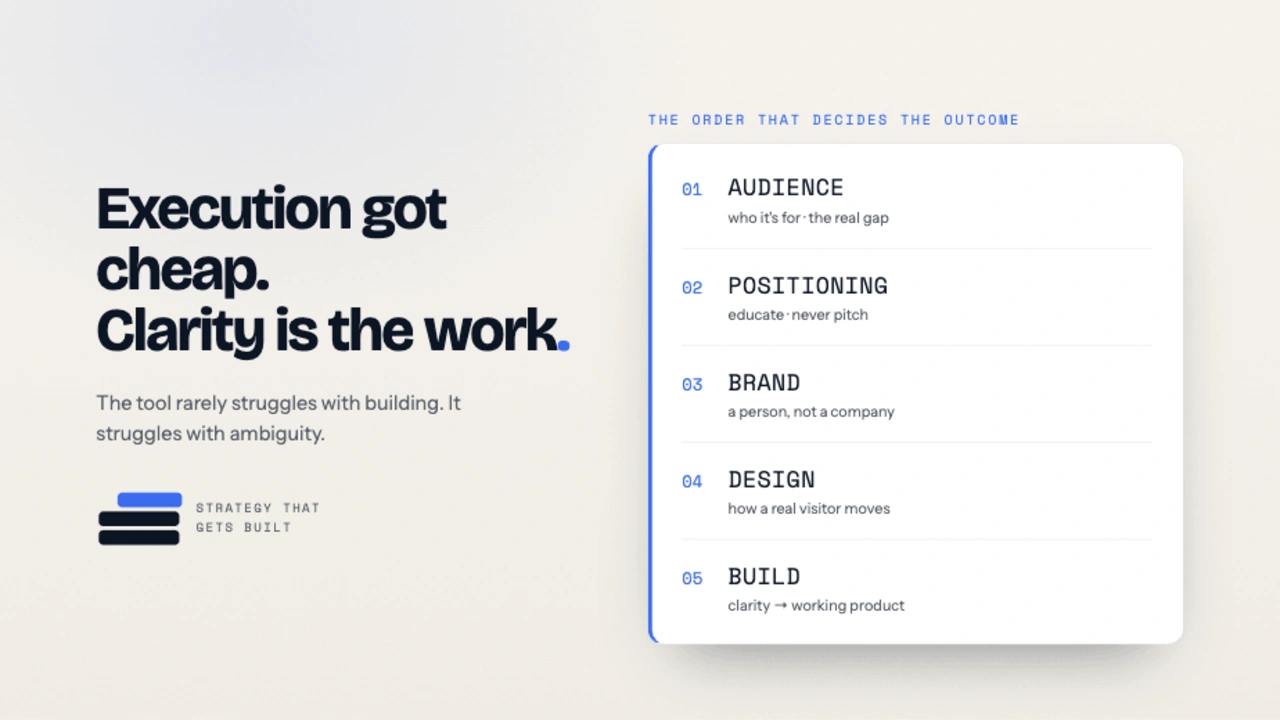
Because the order in which it is built is the order that actually decides the outcome. Audience first. Positioning second. Brand third. Only then came design, development, and launch. The planning is the most important part for the rest of it to fall right. Get that sequence wrong and even the cleanest execution ends up solving the wrong problem.
No doubt, AI has dramatically reduced the effort required to build products. But deciding what to build, who it is for, and why anyone should care still matters more than anything. That part is still the work, and that's what I want to walk through.
Here's how it went, step by step:
01Step 1: Decide the audience
Before anything else, the question was who this was for and what their real problem was.
The answer was specific. There are a lot of people, especially the young audience in college and the ones who have just started working, who want to understand money but keep getting sold to instead of being educated. The education is missing. Everyone else in the room is trying to close them.
Everything downstream was built to serve that audience and solve that gap.
02Step 2: Lock the vision and positioning
Once the audience was clear, the positioning became obvious. This would be an independent financial education platform that never sells anything. No products pushed, and no advice disguised as content. Just helping people understand how money and the markets work.
That single principle, educate and never pitch, became the constraint every decision had to follow.
Positioning is the foundation you build on from the beginning.
03Step 3: Build the brain before building the product
This is where Claude came in.
I created a dedicated project inside Claude and used it as the brain for the entire build. I documented everything about Tarun, his background, experience, communication style, audience, goals, and just as importantly, what he should never say.
For a finance educator, those boundaries matter. There is a clear difference between educating and advising, and that distinction had to remain consistent across every page.
I treated those instructions like a brand playbook. Every rule, every guardrail, and every piece of context lived in one place before a single page was created.
This is the step most people skip, and it quietly determines the quality of everything that follows. The quality of what Claude gives you back is usually a reflection of the quality of the context you provide.
04Step 4: Build the brand
Next came the brand.
We explored different directions. Should it be built around Tarun's personal name, or should it become an independent brand?
We kept coming back to one idea. The value wasn't a company. The value was a real person teaching from experience without an agenda.
That's how Finance with Tarun came to life.
From there, I used Claude Design to explore multiple visual directions before finalizing the logo, colours, typography, and basic brand guidelines.
05Step 5: Design the experience
With the brand in place, I moved to the product interface.
Using Claude Design, I designed every page while thinking about how a real visitor would navigate the platform.
Navigation, usability, SEO, and content hierarchy were considered from the beginning instead of becoming things to fix later.
The objective wasn't simply to make the platform look good. It had to be intuitive, discoverable, and easy to grow over time.
06Step 6: Turn the design into a working platform
Once the design was finalized, I used Claude to generate detailed development prompts and then moved into Claude Code to build the platform.
One thing I was firm about from the beginning was the CMS.
I didn't want Tarun to depend on a developer every time he wanted to publish a new article or update the platform. We built a custom CMS, ran everything locally, tested it thoroughly, and only then deployed it.
One thing this project reinforced is that AI rarely struggles with execution. It struggles with ambiguity.
The more precisely you know what you want, the better the output becomes.
The skill that used to be execution is increasingly becoming clarity.
07Step 7: Launch
The final stage was deployment.
GitHub handled version control, Supabase became the database, and Vercel handled hosting. The domain was managed through Hostinger and pointed to Vercel.
Within a few days, the platform was live.
08The result
The platform is now live at financewithtarun.com.
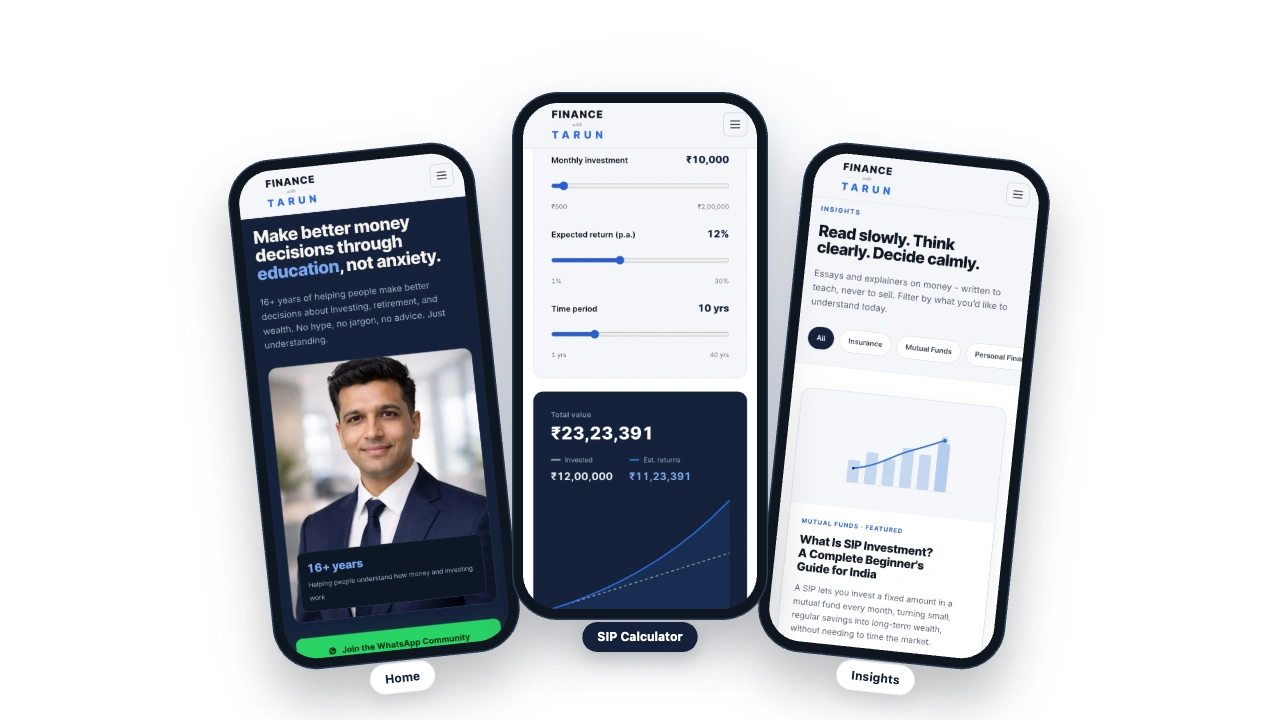
It scores green across both mobile and desktop on Google PageSpeed Insights, and the content is structured so both traditional search engines and AI-powered search can understand it well.
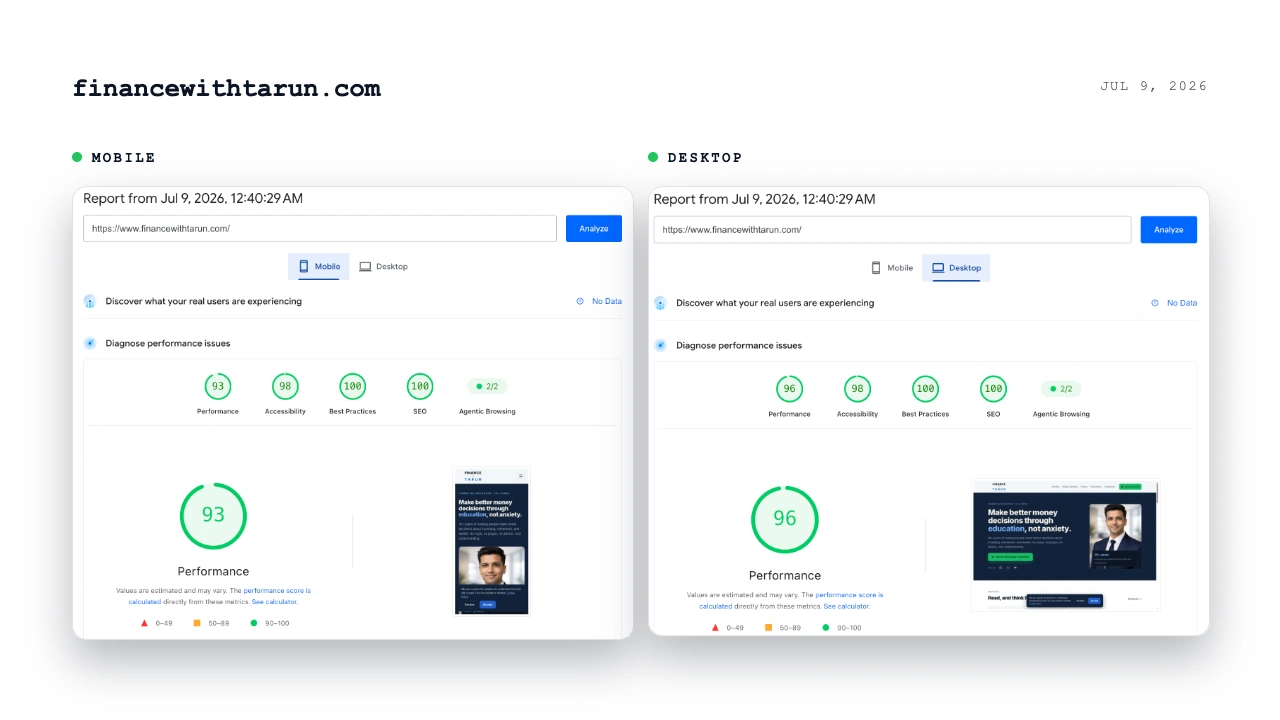
The goal was never just to launch quickly. It was to build something that performs well today and remains easy to grow tomorrow.
09Final thoughts
This article explains the framework and the sequence I followed.
What it can't fully capture is the judgement behind each decision, whether it's about choosing the right audience, refining the positioning, knowing what and how to build, and recognizing when an output needs another iteration.
AI has made execution dramatically faster.
Experience still shapes the outcome.
If you're sitting on an idea and need someone who can take it from audience and positioning all the way to a working product, that's exactly the kind of work I enjoy doing.