Fractional CMO vs Agency: When Each One Actually Wins
When a fractional CMO is the right call, when a marketing agency is, and how to tell the difference, from someone who has run the agency side.
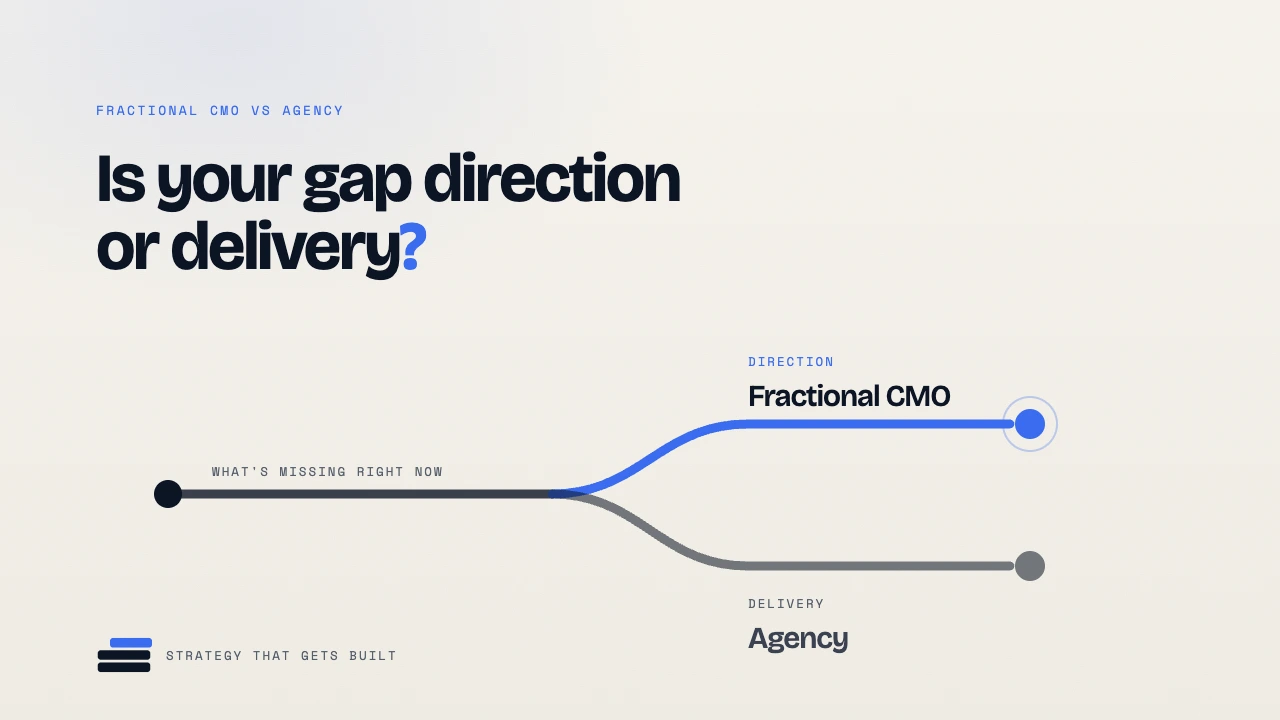
A fractional CMO gives you senior marketing leadership part-time: one person who owns the direction, the plan, and the decisions. A marketing agency gives you execution: a team that produces and runs the work across channels. They solve different problems, so "which is better" is the wrong question. The right one is whether your gap right now is direction or delivery, because that is what decides which you hire.
Summary
A fractional CMO owns strategy and direction. An agency owns execution and output.
Hire a fractional CMO when you are not sure what to do. Hire an agency when you know what to do and need hands to do it.
Many companies need both: the CMO sets the direction, the agency executes it, and the CMO makes the agency spend work harder.
An agency is built around its own utilisation and margin, not your P&L. That is not a flaw. It is the model, and you should know it going in.
The two are priced differently, so the cost comparison is not direct. The full cost breakdown has the ranges.
01What is the difference between a fractional CMO and an agency?
The simplest way to hold it: one decides what to do, the other does it.
A fractional CMO is a senior marketing leader who works with you part-time and owns the whole picture, positioning, the go-to-market plan, budget allocation, channel priorities, and usually the direction of whoever executes, including your agency. They own the direction.
An agency is a team you hire to produce and run marketing across specific channels, performance media, creative, content, social, SEO. It executes to a brief and delivers the work it was hired for. The strategy behind that work still needs an owner.
02Can a marketing agency replace a fractional CMO?
Not really, and it is the most common pattern I saw after years working with founders and marketing teams. Many businesses hire an agency before they are clear on what they actually want it to achieve. They expect the agency to define the strategy, choose the channels, set realistic targets, and then execute everything. That is asking an execution partner to make leadership decisions.
Agencies can contribute strategically, especially good ones. But the business still needs someone to decide where it wants to compete, what success looks like, and what trade-offs it is willing to make. Without that clarity, even the best agency ends up optimising activity instead of outcomes.
An agency can improve a strategy. It can't replace one.
03Fractional CMO vs agency, side by side
Fractional CMO | Marketing agency | |
|---|---|---|
What they own | Strategy, direction, the whole marketing picture | Execution across specific channels |
What you get | One senior head, part-time | A team of specialists |
Who does the work | Directs it, light hands-on | Produces and runs it |
Responsible for | Direction and priorities | Delivering the agreed work |
Cost model | Monthly retainer | Retainer or project, plus a share of ad spend |
Time to value | Week one | Onboarding, then ongoing |
Best when | Direction is the gap | Delivery is the gap |
04When is a fractional CMO the better choice?
Choose a fractional CMO when the missing piece is direction, not hands. The signs are usually plain. There is no senior marketing owner, so the founder is making the calls in between everything else. You have agencies or freelancers, but their work does not add up to one plan. You are about to spend real money and want someone senior deciding where it goes. You are taking something to market, a launch, a new segment, or a repositioning, and the go-to-market needs an owner, not just channels switched on. You are in the early or growth stage, where one right decision matters more than sheer volume of output.
This is the seat that holds the whole marketing picture together. If you already have execution but no one steering it, this is your gap.
05When is an agency the better choice?
Here is where the honest answer matters, because a good part of the time the agency is the right call and a fractional CMO is the wrong hire.
Choose an agency when you already have direction and need execution capacity. You know your strategy and need a team to produce and run it at volume. You need specialist depth at scale, performance media, programmatic, creative production, always-on content, that no single person can deliver. You have someone senior, a founder who knows marketing or a fractional CMO, to direct them. Your bottleneck is hands and hours, not decisions.
An agency's execution horsepower is real. A good one runs more media, produces more creative, and covers more channels than any individual could. When delivery is the constraint, that is exactly what you want.
06How agencies really work, the part clients don't see
I ran agency operations for years, owning the P&L across a large team. This is not a criticism. It is the model, and understanding it makes you a far better buyer.
An agency is a margin business built on utilisation. The people who pitch you are often the most senior in the room, and the people who run your account day to day are usually more junior. The retainer is priced to a target margin, so the natural incentives are to service the account efficiently and to grow the scope over time. There is nothing wrong with any of it. It is how a healthy agency stays healthy.
But two things follow, and they matter to you. The account team focuses on the channels it was hired for, not the whole picture. And no one on that team is looking at how all of it adds up. That part stays with you, or with a fractional CMO helping set the direction. The agencies that do their best work are almost always the ones with someone sharp on the client side directing them. Without direction, even a good agency keeps doing more of what it already does, rather than what your business needs next.
That is the real case for pairing the two.
07Do you need both a fractional CMO and an agency?
Often, yes, and it is the strongest setup of all. The fractional CMO sets the direction and keeps everything pointed the same way. The agency brings the execution horsepower. The CMO briefs the agency properly, reviews the work against the plan, and cuts what is not working, which is precisely the direction a good agency needs to perform. You get senior ownership and delivery capacity without building a full in-house team.
The pairing also makes your agency budget work harder. Most wasted agency spend is not the agency's fault. It is the absence of anyone senior steering it.
08Fractional CMO vs agency: which costs more?
They use different pricing models, so this is not a direct comparison. A fractional CMO is a monthly retainer for senior time. An agency bills for the scope of work and adds a percentage of your media spend on top. For senior direction, a fractional CMO costs far less than building the same seniority in-house. For high-volume execution across channels, an agency is more cost-effective than trying to push it all through one person. The full cost breakdown has the ranges by market and how to compare them properly.
09How to decide
One question settles most of it: is your gap direction or delivery?
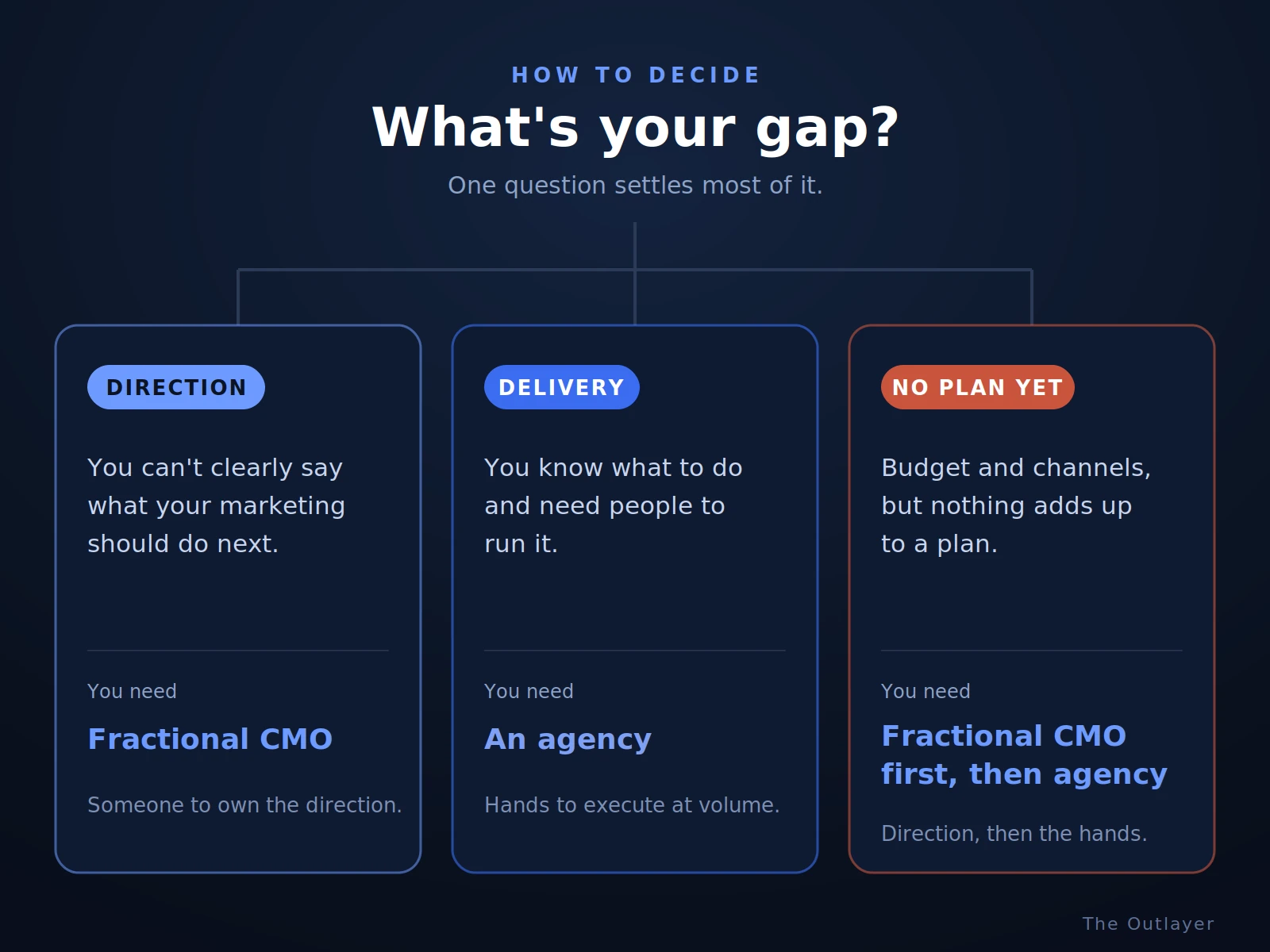
If you cannot clearly say what your marketing should do next, you have a direction gap, so hire a fractional CMO. If you know exactly what to do and need people to execute it, you have a delivery gap, so hire an agency. If you have budget and channels but nothing adds up to a plan, you need the direction first, then the execution under it.
Founders often compare a fractional CMO and an agency because both solve marketing problems.
In reality, they solve different ones.
One helps you decide where to go.
The other helps you get there.
Most businesses don't fail because they picked the wrong agency.
They fail because nobody owned the direction before execution began.
So own the direction first. Then bring in the hands.
Frequently asked questions
What is the difference between a fractional CMO and a marketing agency?
A fractional CMO is a part-time senior marketing leader who owns strategy and direction. An agency is a team that executes marketing across channels. One decides what to do; the other does it.
Is a fractional CMO better than an agency?
Neither is better on its own; they fix different problems. A fractional CMO fixes a direction gap. An agency fixes a delivery gap. Many companies eventually need both.
Can a fractional CMO manage my agency?
Yes, and it is one of the most valuable things they do. A fractional CMO briefs the agency, holds it to the plan, and makes the spend work harder, which is how a good agency does its best work.
Should a startup hire a fractional CMO or an agency?
Usually a fractional CMO first, or a fixed-scope project, because the bigger early risk is pointing spend the wrong way. Bring in an agency once the direction is set and you need execution at volume.
Which is cheaper, a fractional CMO or an agency?
It depends on the need. For senior direction, a fractional CMO is cheaper than the equivalent in-house hire. For high-volume execution, an agency is more cost-effective. The full cost breakdown has the ranges.