Growth Marketing: What It Actually Is, and Why Most of It Fails
Growth is an economics problem wearing a marketing costume.
Growth marketing is the practice of running acquisition, conversion and retention as one connected system. What it gets measured against is the economics of the business, not the performance of individual channels. It is not a channel, a tool, or a set of tactics.
Strip away the vocabulary and what remains is a set of decisions. You decide where the money goes, what it should return, and how quickly you find out whether you were right.
That sounds unremarkable until you see how growth marketing usually gets sold, which is as a collection of clever moves.
- A referral loop that tripled signups for a startup.
- A subject line that lifted open rates.
Those things are real, and some of them work. But they are the output of a system, not a substitute for one. Copy them without the system underneath, and they stop working, and nobody can quite explain why.
I have spent fourteen years on the other side of this, most of it accountable for the number at the bottom. I built a $5M P&L at NP Digital and scaled the India business six times over. Before that, I ran roughly $30M in annual media at AdGlobal360 across programmatic and performance, for brands like Maruti Suzuki, Audi, ICICI, and Dabur.
On this page
01What changes when you own the number at the bottom
I still remember the day I moved from an individual contributor to Director. The Finance Head handed me a sheet with my unit's P&L, and it was full of things I had never once thought about.
Team cost. Salaries. Overhead. Office expense, down to the cost of a seat. My team's revenue sitting next to all of it, contribution margin, profitability, how my unit was performing against the others, the sales target, the upsell target.
Up to that point, I had been responsible for whether my client's campaigns performed. From that seat I was responsible for whether the work itself made money. That turned out to be a completely different question.
A campaign could hit every number the client cared about and still cost more to deliver than it returned. Nothing in the campaign dashboard would ever have told me that.
Everything below follows from that shift. Once growth is a set of decisions with money attached, most of the usual arguments about channels and tactics resolve themselves quickly.
02Why does growth hacking fail?
There is a reason growth hacking became the dominant vocabulary. Tactics are easy to write about, easy to sell, and easy to feel productive inside. A tactic has a beginning and an end. You can put it in a deck, run it in two weeks, and report on it. A system takes months to build and does not photograph well.
I watched what happens when tactics travel without the reasoning behind them. We were running app acquisition for a client, and it was going well. The brand then hired a marketing manager from a competitor, and he rebuilt the whole approach around what had worked at his previous company.
New budget distribution. A different channel split. Channels reintroduced that had already failed for this brand. It was a copy-and-paste of someone else's playbook onto a different set of economics. Within a month, performance was down by 65 to 70 percent.
The cost of that framing shows up later. A business that has collected forty tactics but never built the system cannot answer the questions that actually matter. Which of these is making money after all costs? Which one would break if we doubled the spend behind it? Which of them is buying customers who leave in ninety days?
Without that, every quarter becomes an argument about opinions, and the loudest channel owner usually wins.
The second-order effect is worse. When a business cannot tell which activity is working, it defaults to the activity that reports the best numbers. And the channels that report best are almost never the channels that contribute most, because reporting is a function of attribution, not of value. So the budget drifts toward whatever is best at taking credit.
I saw this clearly on an education account. Search always looked like the strongest platform, and the logic seemed sound. It is an intent channel, and the leads coming through it were higher intent than anything Meta produced. So the brand wanted to keep moving budget into it.
What the dashboard did not show was that the incremental cost of each new lead was climbing steeply. It also did not show that the paid search expansion had started eating the organic leads the brand was already getting for free.
I explained the attribution, and nobody in the room believed it. It took two months of falling numbers to make the case that the analysis could not.
03How does growth marketing connect to the P&L?
Every marketing lever you pull shows up somewhere on a profit and loss statement. That sounds obvious written down, and it is almost never how growth actually gets managed. Four levers matter more than the rest.
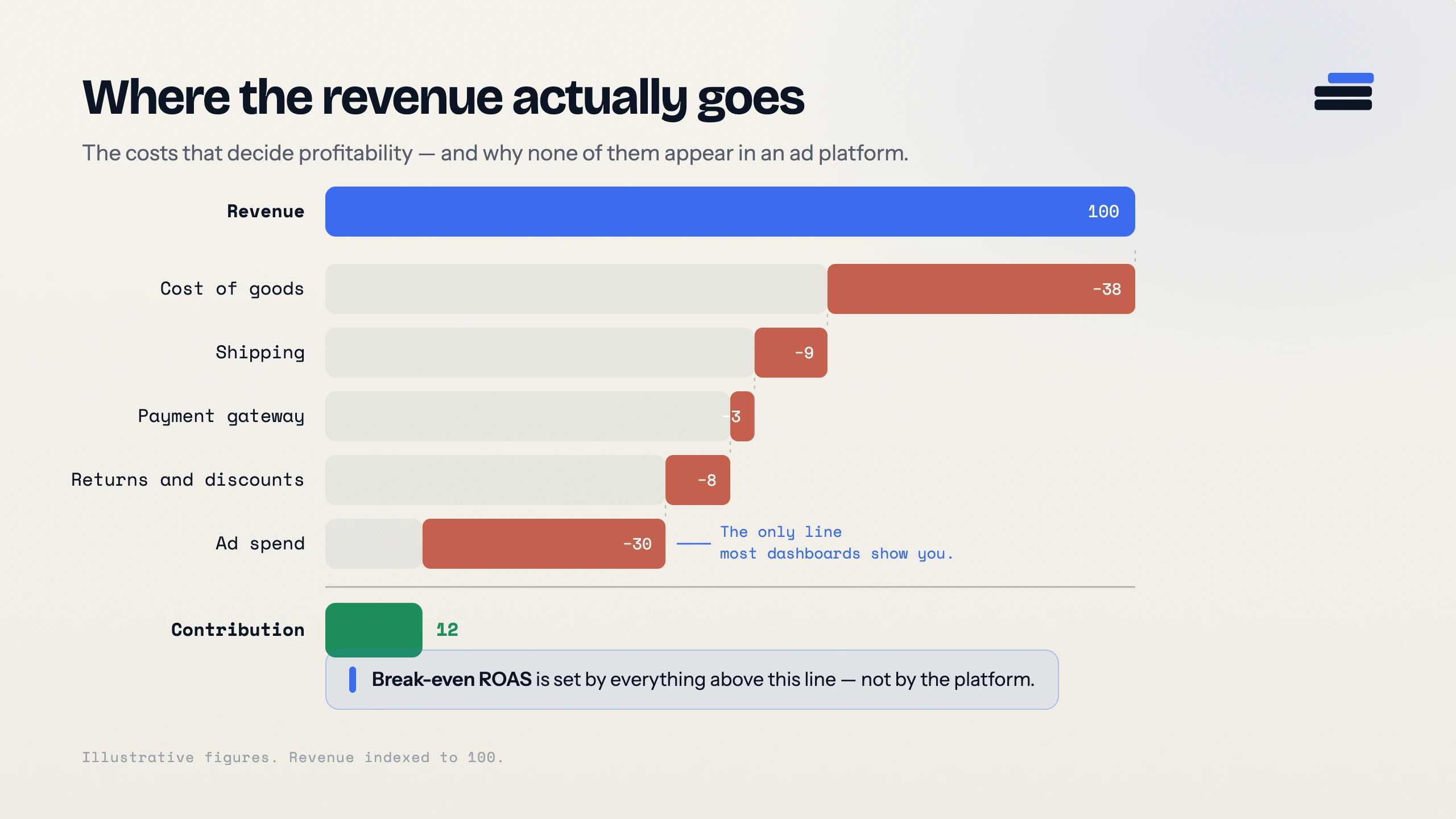
Acquisition spend is a cost of sale. It sits against the gross margin of what you sold. So the honest question is never what the return on ad spend was. It is what the contribution was after cost of goods, shipping, payment fees, returns, and discounts.
A campaign at 4x ROAS can be losing money on every order, and a campaign at 2.2x can be comfortably profitable. The number that decides which is which is your break-even ROAS. It comes from your cost structure, not from a platform dashboard.
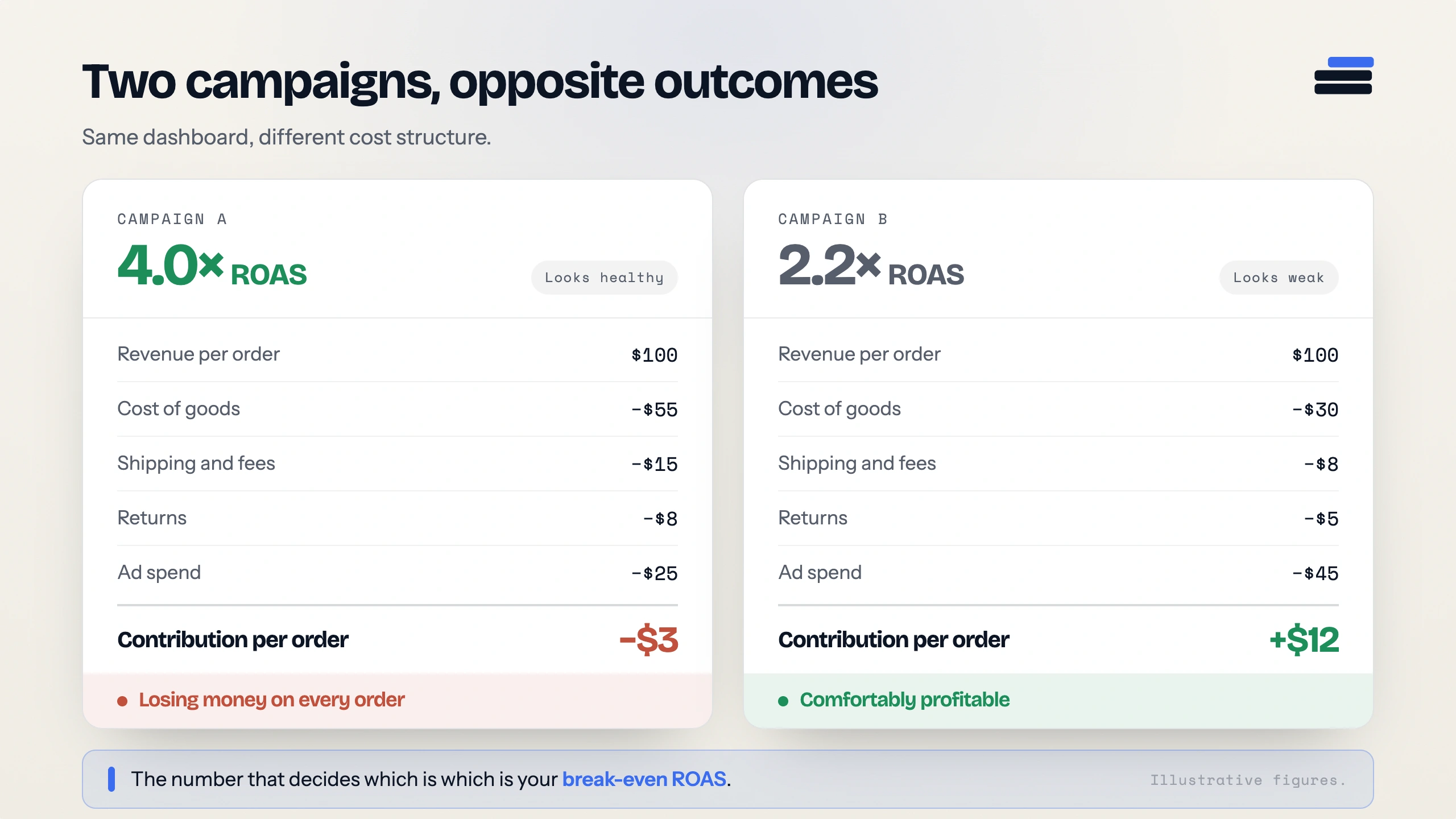
Conversion rate is a margin lever. Improving it does not cost media, so every point of improvement drops almost entirely to contribution. That makes conversion work the cheapest growth available to a business that has been buying traffic for a while. It is also the work most often skipped in favour of simply buying more traffic.
Retention is the whole game, and it is the line item most marketing teams have no ownership of. Repeat customers carry no acquisition cost, so their contribution per order is far higher than a first purchase.
In practice, retention is what funds acquisition. A business with strong repeat behaviour can afford to pay more for a customer than its competitors, and simply outbid them into the ground. A business without it is always one CAC increase away from trouble.
Payback period decides how fast you can grow. If it takes eleven months to recover the cost of a customer, your growth rate is capped by your cash position, not by your marketing ideas. Shortening payback has nothing to do with creative or channels, and almost nobody treats it as marketing's job.
Put those four together, and you get the uncomfortable version. A team that knows its contribution margin, its break-even ROAS, its repeat rate and its payback period can make good decisions with mediocre tactics. A team that knows none of those things cannot be saved by good ones.
Something I keep noticing is that the language of growth has drifted a long way from the language of the business it serves. Finance talks about margin, payback and cash cycles. Marketing talks about reach, engagement and cost per click.
Both sets of words describe the same activity. Only one of them is the language decisions get made in. When marketing cannot speak that language, it argues for budget in words the person holding the budget does not use, and it usually loses on the merits.
04What does a growth marketing system consist of?
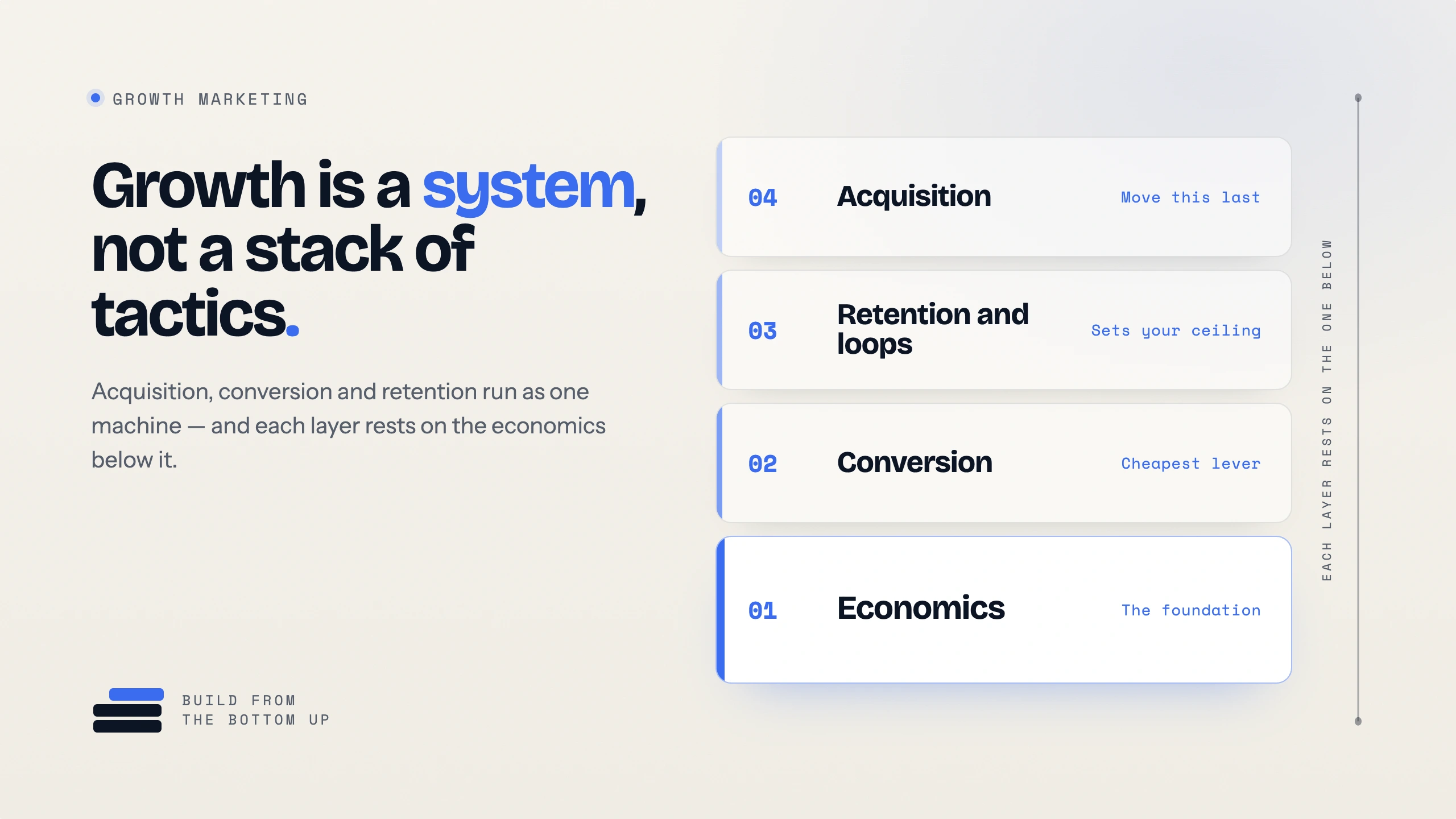
Four layers, each one resting on the layer beneath it.
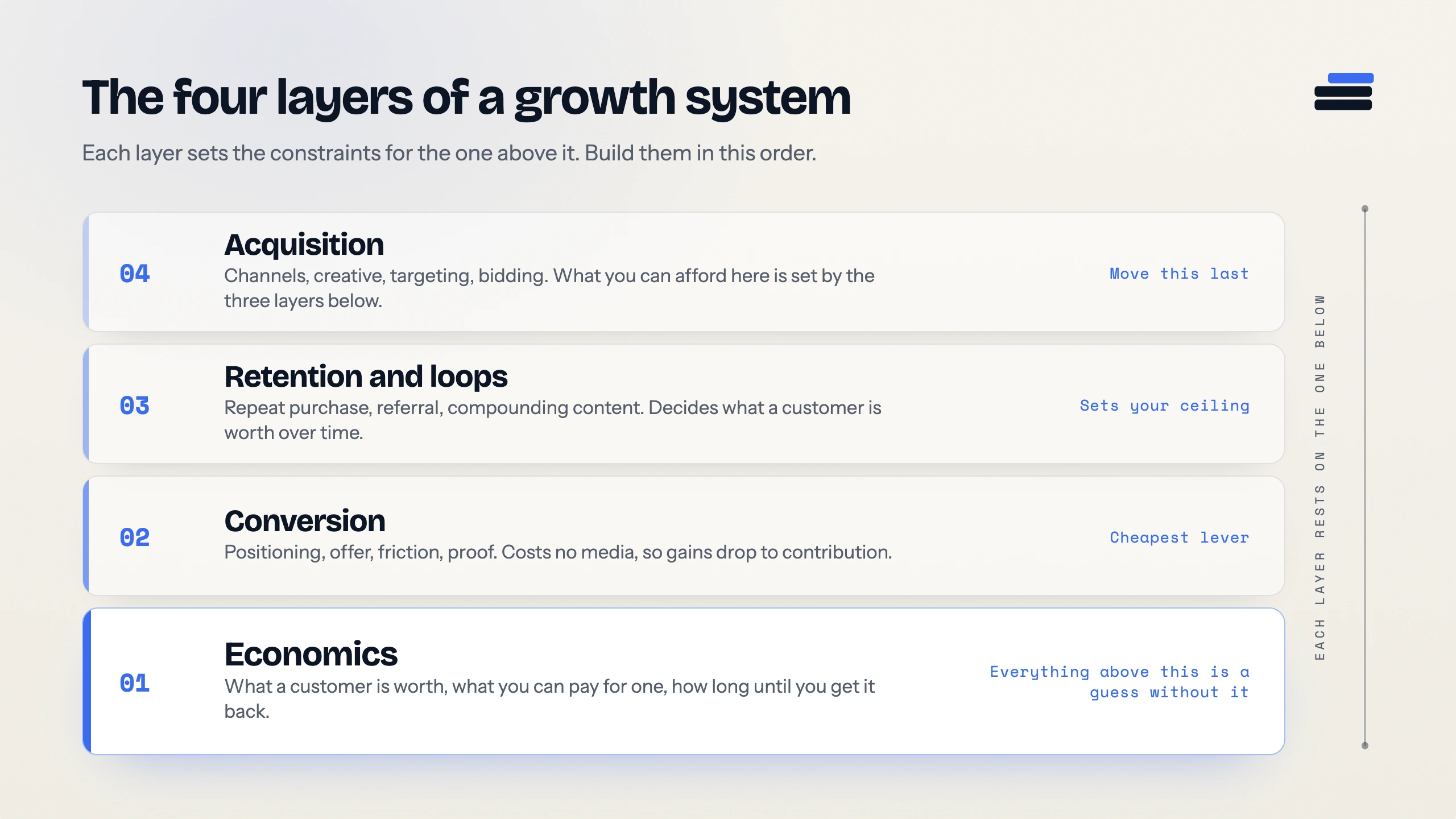
The economics layer. Before any campaign, you need to know what a customer is worth, what you can afford to pay for one, and how long before you get that money back.
This is unglamorous work, usually done in a spreadsheet rather than a platform. It also cannot be outsourced to a dashboard, because the costs that decide it do not live in any advertising dashboards. Cost of goods, real shipping cost, return rates. That is exactly why they are the numbers most often missing. I have written more about this in the growth funnel, where each stage carries its own economics instead of one blended number.
The conversion layer. Everything that happens between arriving and buying. Positioning, offer, page structure, friction, proof.
Improving it costs no media, so every point of improvement drops almost entirely to contribution. It also changes your effective cost per customer without you touching a bid, which is why it is the cheapest growth available to a business already buying traffic. This is the layer where marketing and product start to blur, and it stalls in companies where those sit in different reporting lines.
The retention and loop layer. What happens after the first purchase, and whether the business gets anything back for free. Repeat purchase, referral, content that keeps working, product usage that pulls people back.
This is the layer that decides what a customer is actually worth over time, which is what sets your ceiling on acquisition. It is covered properly in growth loops, because loops behave differently from funnels and get modelled differently.
The acquisition layer. Channels, creative, targeting, bidding. This is where most people start and where most of the visible activity happens.
It sits at the top for a reason. What you can afford to pay for a customer is decided entirely by the three layers underneath it. Your edge here is rarely a secret tactic, because everyone has the same platforms and the same auction. It is usually that you know your true break-even and your competitor does not, so you can bid with confidence where they are guessing.
Each layer inherits the constraints of the one below it. Acquisition decisions made without the economics layer are guesses. Conversion work done without knowing which segment is profitable optimises the wrong journey. Retention aimed at customers you should never have acquired is an expensive loyalty programme for people who were never going to stay.
Which is why acquisition sits at the top and moves last, even though it is the layer everyone reaches for first.
05What this looks like in practice
The clearest example from my own work is the P&L build at NP Digital India. Getting to $5M is usually told as a sales story, and it partly is. But the part that made it repeatable was unglamorous.
We knew what each service line cost to deliver, what it returned, and how long the cash cycle was. That let us decide which work to chase and which to decline. Declining the wrong revenue is a growth decision that no tactics list will ever suggest.
The same logic applied at much larger media scale. Running roughly $30M a year teaches you quickly that depth is not about knowing the interface. It is about knowing which impressions are worth buying, and that means knowing what a customer is actually worth to the business behind the campaign. Two brands can run identical setups and get opposite results, because their underlying economics are different. The tactics were never the variable.
Scaling that India business six times over came from the same place. A system that told us where the next rupee should go and what it should return, applied consistently for long enough to compound.
Growing the team was its own version of the same problem, and it is the part most growth writing ignores completely. Every scaling decision is a chicken-and-egg question with a cost attached. Do you hire the team before you win the client, or win the client and then scramble to deliver?
Hire first, and you carry that cost against your P&L for however many months it takes. So the real question is never whether you can afford the person. It is how long you are willing to carry them before the revenue arrives, and whether you know that number before you sign the offer letter.
06How do you know if you have a growth system or just tactics?
A few honest questions. They are uncomfortable in the right way.
Can you state your break-even ROAS from memory, and does everyone buying media know it? If not, your acquisition spend is being managed against a number with no relationship to profit.
Do you know your contribution margin per order after every variable cost, not just gross margin? Most teams know the second and assume it is the first.
Can you say which channel is genuinely incremental, as opposed to which channel reports the most conversions? Those are different questions, and the gap between them is usually where budget quietly gets wasted.
Do you know your repeat rate and your payback period, and does anyone in marketing own them? If retention lives entirely with product or operations, marketing is optimising the first purchase of a relationship it has no stake in.
If a channel doubled tomorrow, do you know what would break first? Systems have known constraints. Piles of tactics do not.
Those answers matter because they are what let you make the decisions nobody wants to make.
On that same app acquisition account, affiliate grew into something extraordinary. It was cheap, it scaled, and it got so efficient that it was effectively carrying the P&L for every other channel we ran. At its peak, close to half our contribution came from that one source.
The client loved it. We were nervous, because we had seen what a bad day on that channel looked like. Conversions could halve without warning. Cost per acquisition could jump tenfold overnight, and there was nothing we could do from our side when it happened. A channel delivering half your contribution while behaving like that is not a strength. It is a single point of failure with good numbers attached.
So we capped it at around twenty percent of the mix. We pushed budget back into channels with worse reported efficiency, knowing our blended cost of acquisition would rise. We also knew we would have to defend that number in every review until the rest of the mix caught up.
It was an unpopular decision while the affiliate numbers were still beautiful. It was also the reason the brand still had a performance programme the day that channel wobbled.
A business that can answer those questions does not need many clever ideas. A business that cannot will burn through every clever idea it finds and end up where it started. That is the pattern behind most of the growth advice being recirculated online.
07Where should you start with growth marketing?
Start with the economics, even if the data is rough. An imperfect contribution number that everyone knows beats a precise one nobody uses. Get to a defensible cost of goods, real fulfilment cost and return rate, then work out what you can actually afford to pay for a customer.
Then fix the measurement before you touch the spend. If attribution tells you a story that contradicts the bank account, believe the bank account and work backwards. Blended numbers at the business level are less satisfying than channel dashboards, and considerably more honest.
Then work the cheapest lever first, which is almost always conversion, because it costs no media and improves every channel at once. After that, retention, because it changes what you can afford to pay to acquire. That in turn changes what is possible in acquisition.
Acquisition scale is the last thing to push, not the first, even though it is what everyone wants to start with. The specific plays inside each layer are covered in growth marketing tactics, which sit deliberately downstream of this page. Tactics chosen before the system is understood are just expensive guesses.
08Why this matters more than any tactic
There is a version of this argument that sounds like a case for being careful, and that is not the point. Knowing your economics is not a brake on growth. It is the only thing that lets you be genuinely aggressive, because you know exactly how far you can push before the maths turns against you.
The businesses that scale hardest are usually the ones that can prove what a customer is worth. That is why they can outbid everyone else in the same auction and sleep fine about it. Certainty is what buys you the right to be bold.
That is the part most growth advice leaves out. It treats discipline and ambition as opposites, when one is the precondition for the other. If your reporting currently feels like it is describing someone else's business, the fix is not more ideas. It is knowing your own numbers well enough that the aggressive move stops being a gamble, and you can see how I approach that on the growth marketing page.
Frequently asked questions
What is growth marketing?
Growth marketing is the practice of running acquisition, conversion, and retention as one connected system, measured against the economics of the business rather than the performance of individual channels. It covers the full customer relationship, not just the first purchase.
What is the difference between growth marketing and digital marketing?
Digital marketing describes the channels used to reach people, such as search, social, display and email. Growth marketing describes the system that decides how those channels get used, what each one should return, and how acquisition, conversion, and retention connect to the P&L. One is a set of surfaces. The other is the operating logic behind them.
Is growth marketing the same as growth hacking?
No. Growth hacking usually means individual tactics that produced a result somewhere else. Growth marketing is the system that produces those tactics. Tactics copied without the system underneath tend to stop working because what travels between businesses is the reasoning, not the move.
What is the difference between growth marketing and performance marketing?
Performance marketing is the discipline of buying measurable outcomes, usually optimised against a cost per acquisition or return on ad spend target. Growth marketing is the system that decides what those targets should be in the first place, based on what a customer is actually worth to the business. Performance marketing is a layer inside growth marketing, not an alternative to it. Having run large performance budgets, my view is that performance works best when the economics above it are settled, because the targets it optimises against are only as good as the numbers they came from.
Is growth marketing full funnel or bottom funnel?
Growth marketing is full-funnel by definition, because it covers acquisition, conversion, and retention as one connected system. But full funnel describes coverage, while growth marketing describes the operating logic that decides how much goes where. A business can run activity across the whole funnel and still have no growth system if none of those stages is measured against the economics of the business.
What is break-even ROAS?
Break-even ROAS is the return on ad spend a channel has to clear for an order to make money after accounting for every variable cost. That includes cost of goods, shipping, payment fees, returns, and discounts. It comes from your own cost structure and cannot be read off a platform dashboard, which is why campaigns reporting a healthy ROAS can still lose money per order.
Which growth marketing metrics matter most?
Contribution margin per order, break-even ROAS, repeat purchase rate, and payback period. Those four decide what you can afford to pay for a customer and how fast you can grow. Channel-level ROAS and conversion counts describe activity, not profitability.
Where should a business start with growth marketing?
Start with the economics, then fix measurement, then work on conversion, then retention, and push acquisition scale last. Each layer sets the constraints for the one after it, so scaling spend before the economics are understood usually just buys unprofitable volume faster.