AI Automation: What's Worth Building
You know you should use AI. But where do you start, what do you build, and in what order?
Every morning, before I open my laptop, a system I built has already read the day's news across my industry. It scores each story, drops the noise, and writes up the few worth reading. By the time I sit down, the work that used to take my first couple of hours is done. I just read the shortlist and decide what to do with it.
I built that system myself, with no engineering team, in a few evenings. It runs every day whether I think about it or not. And building it taught me more about AI automation than any article I'd read on the subject, because most of those articles describe the shiny version, and the real thing is quieter, more useful, and built differently than people expect.
So this is the honest version. What AI automation actually is, where it pays off, what it costs, and what I learned building one that I now depend on.
On this page
01What is AI automation?
AI automation is using AI to take the repetitive, time-consuming work off your team, so your people spend their time on the work that actually needs them. It is not a chatbot or a single clever tool. It is a system that gathers, sorts, drafts, and routes work in the background, whether that is emails, leads, content, or reports, and brings a person in for the part that needs real judgment.
This matters now because old automation was limited. It could only follow fixed rules. A form comes in; it goes into a spreadsheet. That works when the input is simple and predictable, but most real work isn't.
AI changed what can be automated. My news system is a good example of the difference. A rule-based tool could collect articles for me; that's just fetching. But it can't read them, understand what each one is about, judge which ones are worth my time, and write a short take on each. That part used to need a person, me, reading for a couple of hours every morning. Now AI does the reading and the drafting, and I only do the deciding.
That is the whole shift. The work that resisted automation for years- the reading, the judging, the writing- is exactly the work AI can now start. And most of that work is sitting inside your business right now, quietly eating the hours of capable people who would do more valuable things if it were off their plate.
02Where does AI automation actually pay off?
Here is what I got wrong when I started, and what most people get wrong too. I assumed the exciting, visible thing was the place to begin. A chatbot on the website. An AI that writes all your content. Something you can point to and say "we use AI now."
The better starting point is wherever the work is actually piling up. For a business buried in customer enquiries, that might be a chatbot. For most, the real pile-up is invisible. It's the repetitive internal work, like sorting leads or turning scattered numbers into a report, that quietly eats time every day.
I keep running into this across the work I build. For one client, a finance education platform, the whole content pipeline and the social posting run automatically, which is also linked to their SEO strategy, so the team spends its time on the teaching, not the content creation and publishing. For other clients, I built a reporting dashboard, called decision boards, that pulls the numbers together from different marketing platforms on its own and organises them into a readable, decision-ready format every morning, instead of someone rebuilding a spreadsheet every week. My own news system does the same job for my content. Different businesses, same shape: take the repetitive middle off a person and hand back the time.
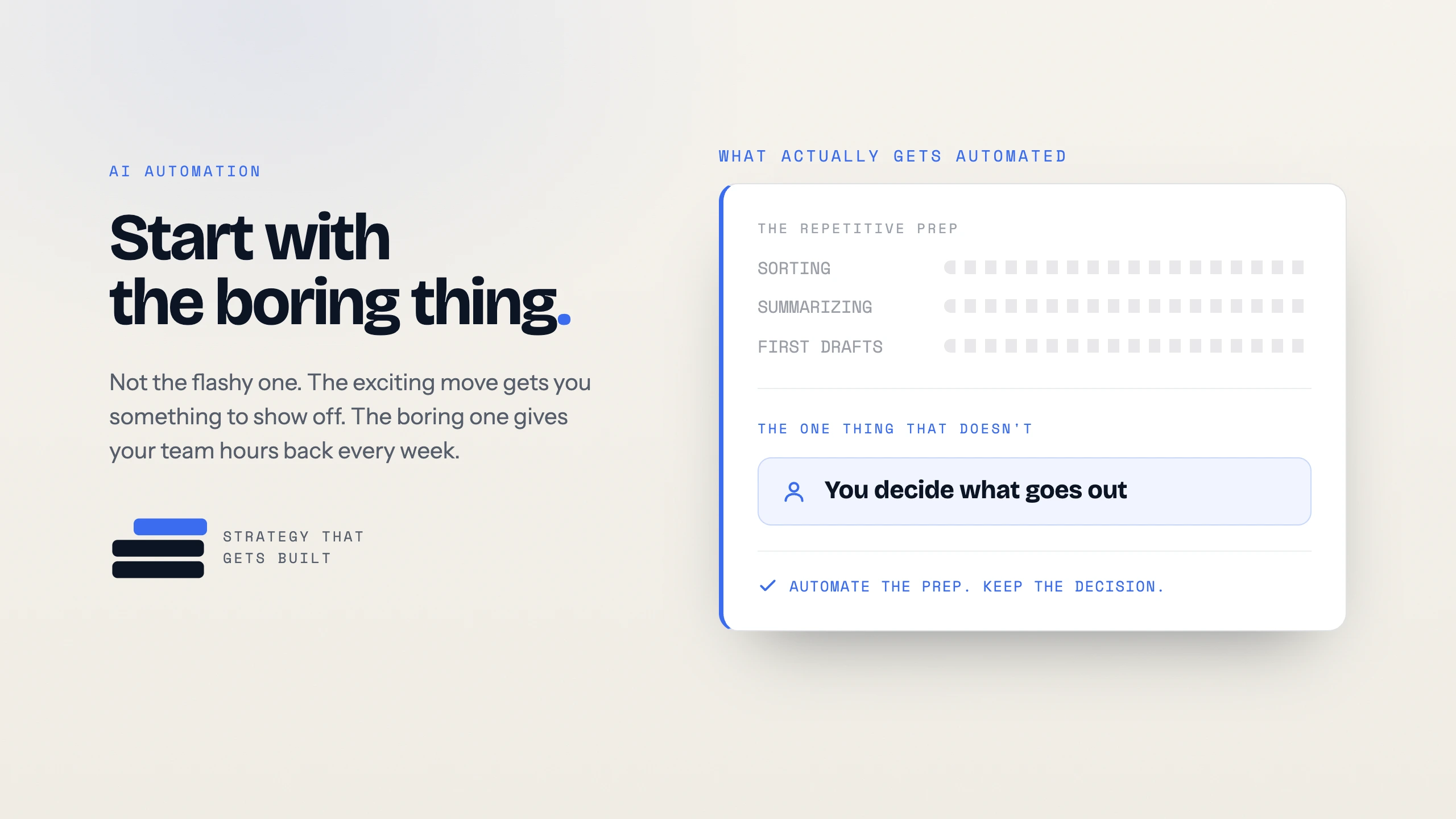
This kind of work is worth starting with for a simple reason. It is boring, high-volume, and low-risk if a step occasionally gets something wrong, because a person is checking before anything goes out. It rarely gets attention because nobody posts about it. But it is usually where the time is quietly going.
There's a deeper point underneath this, and it's the thing most "start with AI" advice misses. The value of AI automation is not in doing something new. It is in taking the dull, repetitive load off your team so they can do more of the work that matters. You are not inventing a new capability, and you are not replacing anyone. You are taking the boring middle of a job that already happens, letting a machine run the first pass, and giving your people their time back for the work only they can do.
Start with the flashy thing, and you get something to show off. Start with the boring thing, and you give your team hours back every week.
03What does a real system look like? A walkthrough
Let me walk through one system in full: the news radar I built for my own content. It's easier to understand one system fully than to read about the idea in the abstract, and my dashboards and client pipelines all work the same way. Once you understand this one, you can see how almost any repetitive task could work the same way.
It runs as a chain of small steps, each doing one job and passing the work to the next.
First, it gathers. It pulls in articles from a set of sources I chose, the publications and feeds that are actually relevant in my category, and collects everything new since the last run.
Then it scores. This is where AI comes in. It reads each article and rates it on what I care about: is it relevant, does it have a real point of view, would my audience care? I use a cheaper, faster AI model here, because a hundred articles a day adds up, and the cheap model is plenty good at spotting what's worth a closer look.
Then it filters. Anything that scores below a set mark gets dropped. This step saves me the most time, because most of what gets published each day is noise, and I never see it. The default is to discard. Only the few good ones make it through.
Then it drafts. For the articles that made it through, a stronger, more capable AI model writes a short take, what the story is, why it matters, and my point of view on it. The stronger model costs more per use, but I'm only running it on the handful that survived the filter, so the cost stays small.
Finally, it routes. Each one that makes it through lands as a card in ClickUp, where I plan my content, and the draft comes ready to use, shaped as a social post, a creative brief, or a note on the type of creative to make. All I do is review it and decide what to take forward.
The system never decides what gets published. It just brings the relevant pieces for my approval, based on the instructions I have set. Even if it scores something wrong, the worst that happens is I review one extra item, or I miss one I might have liked. The cost is never that something wrong goes out under my name, because nothing goes out without me. That's what makes it safe to run unattended, every day, without me watching it.
It didn't work at first, though.
The problem was the scoring. Every article gets scored out of ten on the criteria I've set, like relevance and whether there's a real point of view, and it has to clear that threshold to get through.
I set that score too low at first, and got flooded, seven or eight pieces a day, a lot of it general news with no real angle. So I raised it, and then nothing came through for days. It took some trial and error to find the level where one genuinely good piece reaches me. You don't get the settings right on day one. You get them right by running it and adjusting.
04Does the automation actually pay for itself?
Before you build anything, ask one simple question. Is it worth it?
AI automation is not free. There is the cost to build it, the cost to maintain it when a source changes or something breaks, and the running cost, because AI charges you every time it works. Every time a system reads, scores, or drafts, there's a small bill attached, and it repeats for as long as the system runs.
How you build it decides whether it makes money or loses it. On my news system, I score every article with a cheap model and only run the expensive one on the few that pass the filter. Same output, a fraction of the cost.
It's entirely possible to automate something, make it work beautifully, and still lose money on it, if what you spend building and running it is more than you were spending before. The efficiency is real, but if it costs more than it saves, the business is worse off, not better.
So the first step is never building. It's a simple check. What is this task costing me now, in hours and money? What will it cost to build, run, and maintain? Is the gap big enough to be worth it?
Sometimes the honest answer is no. If a task only comes up twice a month, or takes you ten minutes by hand, automating it usually isn't worth the cost. What pays off is the repetitive, everyday work, where the small time savings add up over a year. My news system was worth it because it runs every single day and saves me a couple of hours each time. It also keeps me posting consistently. Without it, I'd be relying on having the time and the mood to keep up, and some days I simply wouldn't.
Know the economics before you act. The goal is a more efficient business, one where your people spend time on what matters instead of repetitive work. But that efficiency has to be worth what it costs. If the automation costs more to run than the time it saves is worth, you haven't gained anything; you've just moved the cost around.
05When should a person stay in the loop?
There are three areas where I'm much more cautious: important judgment, anything that reaches a customer without a person checking it, and anything involving money or compliance.
But I don't think the answer is to never let AI make a decision. The better question is what happens if it gets the decision wrong.
My news radar makes decisions every day. It decides which articles are worth bringing to me and which aren't. I'm comfortable with that, because the cost of getting it wrong is small. I might review one article I didn't need to, or miss an idea I'd have liked. Nothing goes out under my name without me seeing it.
That's very different from letting the same system decide what gets published, send a customer a reply, move money, or make a compliance call. There, the cost of being wrong is high, so I want a person involved.
The rule I use is simple. Automate decisions where the cost of being wrong is low. Keep a person involved where the cost of being wrong is high.
There's one more reason I protect the important decisions, and it's the one I feel most. You get better at making decisions by making them. The less you decide, the worse you get at deciding. The boring prep is worth automating because doing it by hand teaches you nothing. The decisions worth keeping are the ones that make you a little sharper every time.
06How do you start with AI automation?
Start small, and start with your own work before anyone else's.
Pick one task you do every week that's mostly prep work and barely any decision-making. Something repetitive, full of information, and safe enough that a rough draft won't cause any harm. Not the biggest problem in your business, the most boring one you can find, because boring and repetitive is exactly where AI helps most and where a mistake costs the least.
The way to do it is simple. Build the smallest version that takes the task off your plate but leaves the deciding to you. Run it for a couple of weeks, see where it gets things wrong, and fix it. Only once it's clearly saving you time should you think about what else could work the same way.
If you want help working out what's worth automating in your own business, and building it so your people stay at every decision that matters, that's something I help with. More on the AI automation page.
Frequently asked questions
What is AI automation?
AI automation uses AI to run repetitive, information-heavy tasks inside a workflow, so the work happens in the background, and a person only steps in for the decisions that need them. It differs from older rule-based automation because it can handle language and judgment-adjacent work, like reading, sorting, summarising and drafting, rather than only clean, predictable triggers.
What is the difference between AI and automation?
Automation follows fixed rules and only works when the input is predictable. AI and automation together handle the messy part, where the input is words or context, not a fixed rule. Plain automation adds a new signup to your email list. AI automation reads a hundred messages, works out what each is about, sorts them, and writes draft replies for a person to approve.
What should a business automate first with AI?
Start with high-volume, repetitive work that is mostly preparation and barely any judgment, and where a mistake is low-risk because a person checks before anything goes out. Sorting enquiries, pulling scattered information into summaries, and drafting first versions are common first wins. Automate the work around the decision, not the decision itself.
Is AI automation worth the cost?
Only if it pays for itself. AI automation carries a build cost, a maintenance cost, and a running cost, since AI charges you each time it works. It is worth it when the task is high-volume and repetitive, so the time and money saved outweigh what the automation costs to run. It is rarely worth it for occasional or quick tasks. Run a simple cost-benefit check before you build.
Do I need engineers to build AI automation?
No. Many practical AI systems are built by connecting a workflow tool, a database, and AI models, without custom engineering. I built mine myself with no engineering team. The harder part is not building. It is deciding what to automate and designing it so a person stays at every decision that matters.
What should you keep a person involved in?
Keep a person on any decision where being wrong is costly: anything that reaches a customer, touches money or compliance, or carries your name. The simple rule is to automate decisions where the cost of being wrong is low, and keep a person involved where it's high. Gathering and preparing information is safe to automate. The high-stakes final call is not.