Go-to-Market Strategy: The Plan Is the Easy Part
The plan is rarely the problem. Launches are won in execution, in how fast the work reaches the market and how quickly it changes once it's there.
A go-to-market strategy is the plan for how a company brings a product to its market. It defines who the product is for, what problem it solves, how it is positioned, which channels carry it, how it is priced, and how it is sold.
On this page
The strategies that work and the ones that quietly lose momentum usually look similar on paper. The difference shows up later, in how fast the plan reaches the market and how quickly it changes once it does. A go-to-market strategy is not won in the document. It is won in what it delivers.
I have spent fourteen years on the execution side of this, running launches across India, the UAE, the US, and Australia, for brands as different as a premium car channel and a fine jewellery house. The plans were rarely the problem. The gap between a good plan and a working one was almost always speed.
I once worked with a luxury jewellery brand based in New York and Dubai. The campaign was designed by their brand agency, and I was the one responsible for launching it on digital. The GTM deck looked fancy, but it was not planned with digital in mind. The promoters were based in NY, the campaign was planned for Dubai, and I was based in India with half the details. Long story short, the campaign went live after a year.
01What a go-to-market strategy actually covers
Before the argument, the components, because you deserve the clean answer first. A complete go-to-market strategy has six moving parts.
The market and the ideal customer. Not a broad segment, but a specific buyer with a specific problem urgent enough to pay to solve. The narrower this is at the start, the faster everything downstream moves.
The positioning and message. What the product is, who it is for, and why it is the obvious choice for that buyer over the alternative they are using today, including the alternative of doing nothing.
The channels. Where that buyer already spends attention, and how the product reaches them there. Search, social, partnerships, outbound, events, or some mix, chosen because the buyer is there, not because the channel is fashionable.
The pricing and packaging. How the product is bought, at what price, on what terms, and how that maps to the value the buyer actually feels.
The sales motion. How the sale happens in practice. Self-serve, sales-led, or a hybrid, and what a buyer moves through from first contact to signed.
The metrics. The small number of signals that tell you the plan is working or needs to change, read early and often.
Get these six right on paper, and you have a competent go-to-market strategy. Most teams do. Which is exactly why the plan is not where launches are decided.
02Why good plans lose momentum
Here is the pattern I have watched again and again. A large brand builds a strong plan over three months. The research is thorough, the positioning is sharp, the deck is genuinely good. Then it meets the approval chain, and the plan sits there, refined and re-refined, while the market it was built for shifts underneath it.
I was managing a large fintech client launching a digital financing portal, no branches, no paperwork, pure digital. First of its kind in India. Everything was ready except one thing: the positioning line. The Executive Directors were down to two options and could not agree on the final one. We were six weeks into this discussion, and the campaign was just a click away. After six weeks, we ran a four-week A/B test campaign to decide which line got more engagement within the same audience group. It took ten weeks, start to finish, to decide the line. By the time it was decided, the enthusiasm was gone, and a competitor had launched. They were no longer the first.
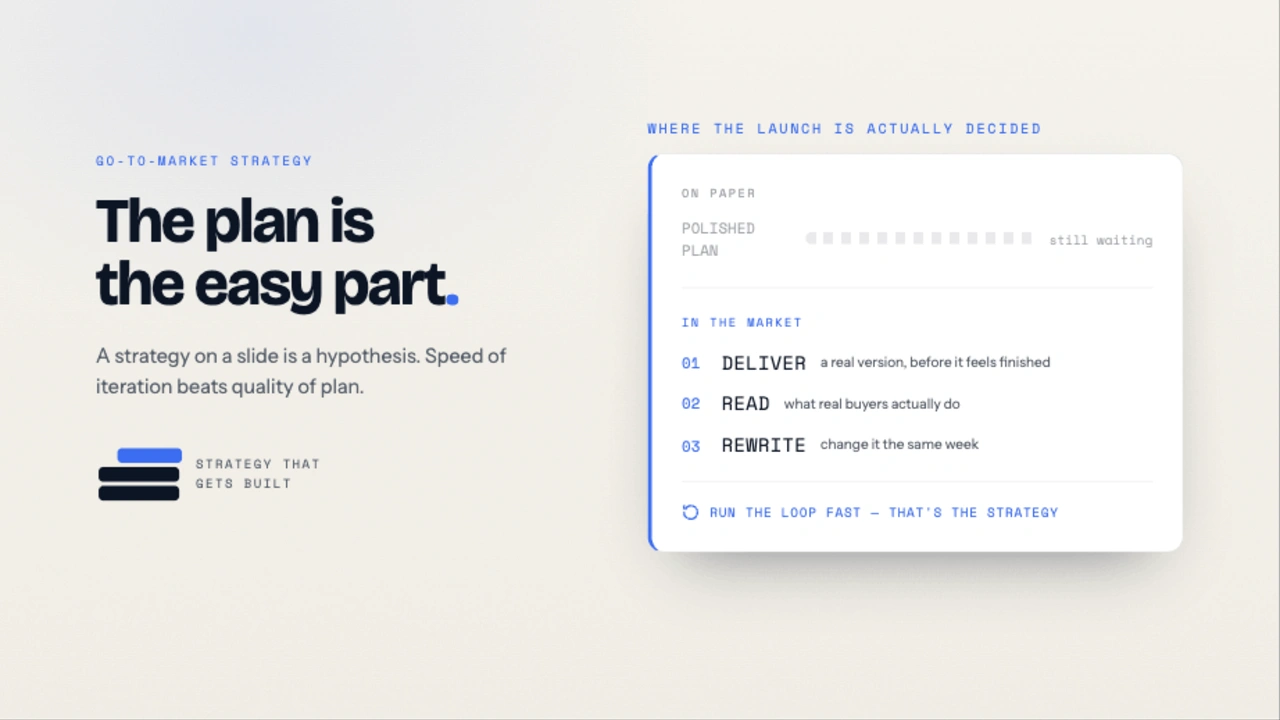
Meanwhile, a startup with a rougher plan is testing three landing pages in the time the big brand spent aligning on one line. It puts a version in front of real buyers, reads what happens, and changes the message the same week. The plan on paper was weaker. The plan in the market was stronger within a fortnight, because it was learning, and the polished one was still waiting.
That is the thing most go-to-market advice skips. A strategy on a slide is a hypothesis. It is worth very little until the market tests it, and the market cannot test what has not launched. The teams that win are not the ones with the best plan at launch. They are the ones who get a real version into the market fastest and change it quickest once the market answers back.
Speed of iteration beats quality of plan. Not because planning does not matter, but because the plan is only ever a first draft that the market rewrites.
03The parts that decide it, through an execution lens
Look at the same six components again, but this time through what actually happens after launch rather than what goes in the deck.
The market read. On the slide, it is a segment. In practice, it is how quickly you narrow to the buyer who actually converts, and how willing you are to cut the ones who do not the moment the data says so. A launch that stays broad to feel safe learns slowly. One who commits to a narrow buyer learns fast and widens later from a position of proof.
The message. This is where it shows up hardest. A positioning statement sits in a document. The message that matters is the specific words in front of a specific buyer, live, tested against a real alternative. What you launch with is almost never what works. What counts is how fast you find the version that does, and that happens in the market, not the review meeting.
The channels. These get treated as a media plan. What actually decides a launch is narrower: where you show up first, how fast you double down on the one that returns, and how quickly you drop the ones that do not. Most launches spread thin across everything to avoid missing out. The faster move is to find the single channel where the buyer already is, win there, then expand.
The motion. It is not the funnel diagram. It is the real path a buyer walks from first contact to signed, and every point of friction you strip out of it. This is where speed compounds quietly. A motion with one less approval, one less form, one less wait closes faster every week it runs.
I was leading a subscription campaign for an OTT with a steep target. The pressure was to do more, spend more, and push more. But we could see users dropping off the landing page. The subscription flow asked for too much up front: name, email, phone, and plan, all mandatory before you got anywhere. We had to increase the conversion rate, so we offered a landing page with just one field to start with, a phone number or email, and on verification, the user could simply choose the plan and make a payment. Result: our conversion rate went up 3X. Same campaign, same audience; we just removed the effort.
None of this lives in the plan. All of it lives in the weeks after launch, in how fast the team reads the signal and acts on it.
04A launch, in practice
You see this most clearly when two launches run side by side. One is a legacy brand that has been planning its campaign for months. The other is a startup preparing its first-ever campaign.
The legacy brand has everything the startup wishes it had. Trust, recognition, budget, a market that already knows the name. The startup has none of that. What the startup has is speed. While the established brand moves through its layers of sign-off, the newer one delivers, watches, and adjusts, then delivers again.
The lesson is not that startups are better or that big brands are slow by nature. It is that each has exactly what the other needs. The big brand has the equity a startup spends years building. The startup has the execution urgency that a big brand spends years losing.
The best go-to-market work borrows from both. It thinks like a brand builder about equity and positioning, and it moves like a founder about getting a real version into the market and learning from it. If you are launching from a startup, hold the brand-builder's discipline about who you are and what you stand for, but keep the founder's speed. If you are launching inside a large brand, keep the equity and ask the harder question about your own process: is it helping the work reach the market, or just delaying it?
05How to build a go-to-market strategy that delivers
A practical sequence, built to move rather than to sit in a folder.
Start with one buyer, not a segment. Pick the single customer with the most urgent version of the problem. Everything gets faster when the target is narrow, because every later decision has a clear answer.
Write the message as a claim you can test, not a paragraph you can admire. One sentence a real buyer either agrees with or does not. If it cannot be tested in the market this month, it is too abstract.
Choose one channel to win first. Find where that buyer already is and commit there before spreading. One channel worked better than five channels dabbled.
Design the shortest honest path from interest to signed. Map the real motion and cut a step. Then cut another. Friction removed early pays back every week the launch runs.
Set two or three signals you will read weekly. Decide the progression metrics before launch. Reach and impressions are not a success metric; they are a delivery metric, so do not count them; they only tell you the message is reaching the audience. The progression looks more like this. In the first week, you start to see CTRs and people landing. In the second, the CTRs improve, and you see activity on the landing page, time spent, and engagement. In the weeks after, engagement rises, and conversions climb, and that is when you start evaluating ad and landing-page performance to improve the numbers. Four weeks is a fair window before you judge the key metrics and make changes.
Launch a real version before it feels finished, then change it fast. The market is the only reviewer whose feedback counts. Get in front of it, read what it says, and rewrite. That loop, run quickly, is the strategy.
A go-to-market strategy built this way is lighter on paper and stronger in the market. It expects to be wrong at launch and is built to correct fast, which is the only kind of plan that survives contact with real buyers.
06The part that matters
The deck will get most of the attention. It is the visible artefact, the thing the room reacts to. But the launch you remember, the one that actually moved the business, was not decided by how good that plan looked. It was decided by how fast a real version reached the market and how quickly it changed once it did.
So when your next launch is being planned, protect the speed as fiercely as the strategy. Ask whether the process is carrying the work toward the market or holding it back. The plan is the easy part. What launches, and how fast it learns, is the whole game.
That is where a launch is won, and it is where the work should go.
If you are planning a launch or working through your go-to-market and want a second set of eyes, that is the kind of thing I do.
Happy to help. You can see how I work and reach out here.